

The box says sixty to ninety minutes. It has been two and a half hours, you are on round six, and one player is holding two cards over the board like they are defusing a bomb. Everyone else is on their phone. This is the quiet way a great game becomes a chore, and almost every group has lived it.
The good news is that slow play is rarely the game's fault, and it is almost always fixable. Below are the real reasons games drag, a set of fixes that work without sucking the fun out, and the one change that reliably moves the needle when nothing else has.
Why games actually run long
You cannot fix a pace problem until you know which one you have. There are usually four, and they call for different answers.
- Analysis paralysis. One player treats every turn like a doctoral defense, weighing branches that barely differ. The more options a turn offers, the worse it gets, which is why heavier games suffer most. It is the single most common complaint in the hobby, and it has a whole vocabulary of its own.
- Downtime. The wait between your own turns. It grows with every extra player, and it is what actually makes a table feel slow even when no single turn is that long. A disengaged player also takes longer when their turn finally comes, so downtime feeds on itself.
- Rules friction. Stopping to look things up, explaining a phase again, arguing an edge case. Common with a new game or a rusty group, and almost always front loaded into the first thirty minutes.
- Overhead. Setup, shuffling, scoring, and cleanup. It rarely feels like the problem, but across a long session it quietly adds a half hour nobody remembers spending.
Analysis paralysis and downtime are the two that ruin evenings, and they feed each other: long turns create long waits, long waits make people disengage, and a disengaged player takes even longer when their turn finally comes because they stopped paying attention. Fix those two and the evening comes back.
The math of downtime
It is worth seeing the numbers, because they explain why the same game feels fine one night and unbearable the next. Downtime is not your turn length, it is everyone else's, added up. If four other players each take two minutes, you wait eight minutes between your own turns, every single round.
That is why player count is the hidden dial on pace. Add one person to a five player game and you have not added one turn of waiting, you have added one turn of waiting every round for the rest of the game. It is also why a tighter clock helps most in exactly the games that feel too long: shaving thirty seconds off each turn at a six player table saves two and a half minutes of everyone's waiting per round, which across ten rounds is most of an hour handed back to the evening.
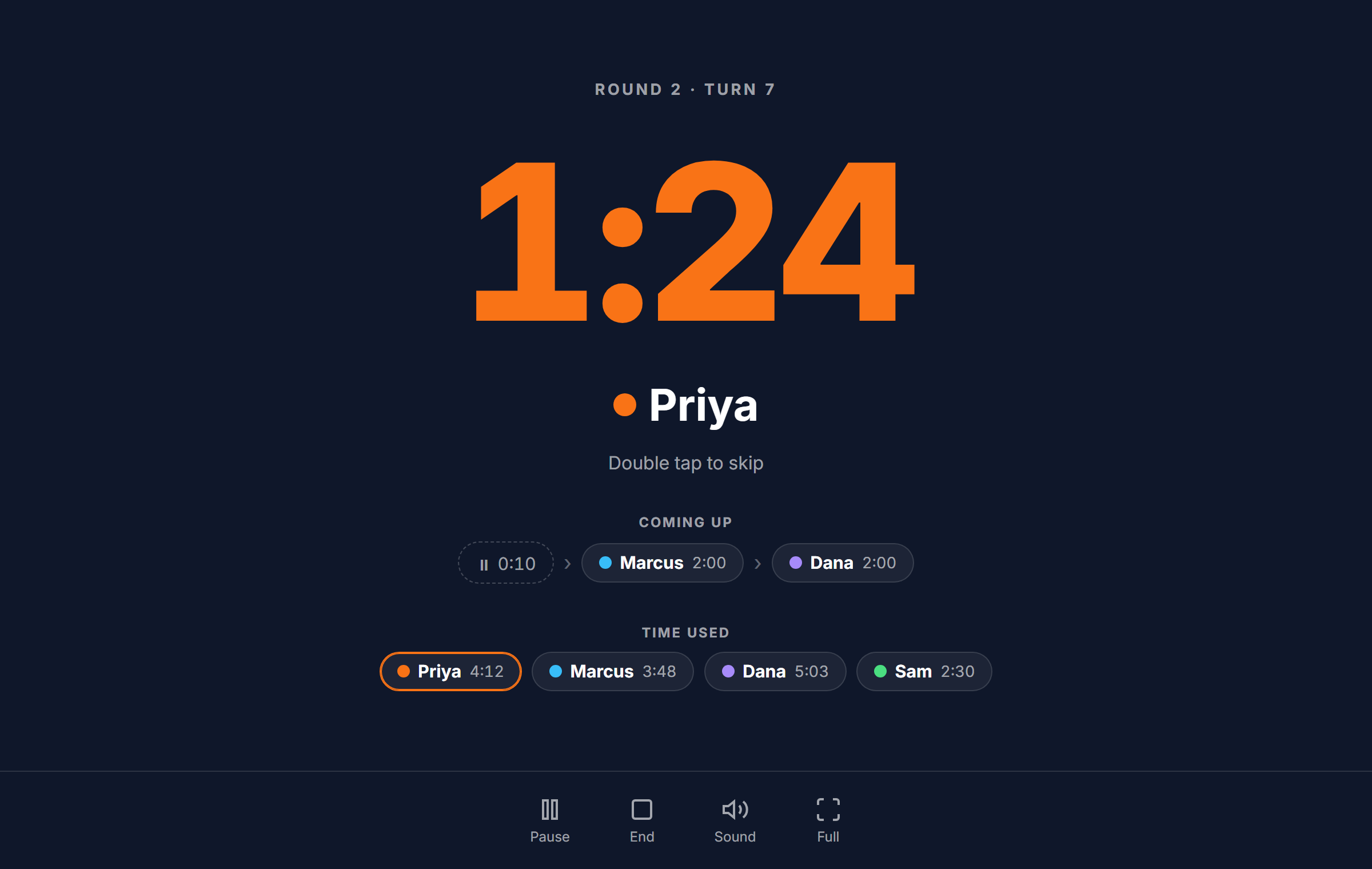
When a clock is the answer, this is what it looks like in play: each player has their own time, the countdown runs for whoever is up, the next few turns are queued so nobody is caught off guard, and a running total shows where the time is going.
Fixes that need no clock
Start here, because a lot of slow play has nothing to do with time pressure and everything to do with habits and setup. Several of these cost nothing and help every game you own.
- Teach the game well. Most rules friction is loaded up front. A clear, confident teach that covers the win condition first saves twenty minutes of confusion later in the game. Tell people what they are trying to do before you tell them how the pieces move.
- Plan on other people's turns. The single biggest fix for analysis paralysis is a table norm: think ahead while you wait, so your turn starts with a plan instead of a blank stare. Say it out loud at the start of the game so nobody feels rushed when it is their go.
- Resolve things simultaneously. Where a game allows it, have everyone pick cards, draft, or plan at the same time rather than one after another. Many games hide simultaneous options in plain sight, and using them can halve a round.
- Appoint a rules referee. One person who knows the game handles questions so play does not stop for a group huddle around the rulebook every time an edge case comes up.
- Cut the overhead. Sleeve and organize the box so setup is fast, keep a scoring pad ready, and clean up as you go. Small, but it compounds across a long game.
- Match the game to the night. A weeknight with tired people is not the time for the four hour epic. Save the heavy box for when everyone has the runway, and keep a couple of forty minute games on hand for when they do not.
These help, and for some groups they are enough. But they all rely on everyone cooperating, and they do nothing for the one player who genuinely cannot stop optimizing. For that, you need something the table does not have to enforce by hand.
A five minute pregame routine that saves an hour
Most of a game's slowness is decided before the first turn, in how you set up and teach. A short routine at the top of the night pays for itself many times over.
- Teach the goal first. One minute on how the game is won, before any rules on how pieces move, so every later rule has somewhere to land.
- Set up while you teach. Lay out the board and deal components as you explain them, rather than teaching and then setting up as two separate chores.
- Name the slow spots. If you know a phase that always bogs down, flag it up front and agree how you will handle it, so it is a plan and not a surprise.
- Agree the pace norm. Say out loud that everyone plans on other people's turns, and if you are using a clock, set it now and show people the number so nobody is startled by it later.
None of this is dramatic, and that is the point. Five minutes of structure at the start removes most of the friction that would otherwise leak out across the next two hours, one looked up rule and one confused turn at a time.
Table habits that quietly speed everything up
Beyond any single fix, a few small habits compound into a noticeably faster night, and none of them require a timer or a rules change.
- Keep hands moving during downtime. Shuffle for the next round, tidy your area, and tee up your resources so your turn is action, not admin.
- Announce your plan as you go. Narrating the broad strokes of a turn keeps you committed to it and lets the next player start thinking about theirs.
- Bank the easy decisions. If a choice is obvious, just make it; save the deliberation for the turns where it genuinely changes the game.
- Score as you play. Track points along the way where the game allows it, so the end is a quick confirmation and not a ten minute audit.
These are the invisible fixes: nobody notices them working, but a table that has them finishes a game a full round or two sooner than one that does not, without ever feeling rushed.
The fix that reliably works: a visible clock
A turn timer solves the two problems that matter, and it does it without anyone having to play the villain. When there is a countdown everyone can see, the slow player speeds up on their own, the fast players stop feeling punished for being decisive, and downtime shrinks because turns stop sprawling. People respond to a visible clock the way they respond to a traffic light. They just comply.
The fear is always the same: won't a timer make people play worse, or turn a relaxed hobby into a stopwatch drill? In practice it is the reverse. Given a limit, players commit to a plan and adapt, which usually produces a better game than an exhaustive search for a slightly better move. The pressure sharpens decisions more than it spoils them, and it caps the total game length as a bonus: a ninety second turn timer across ten rounds keeps a five player game's turn phase to about seventy five minutes, full stop.
Our free board game turn timer is built for exactly this: add everyone playing, give each of them a time, and it counts down for whoever is up and passes to the next person when they finish or when time runs out. If you are not sure what to set, the recommended settings for popular games give you a starting number for Catan, Terraforming Mars, Scrabble, and more, and the game timer guide covers the wider case across chess, party games, and roleplaying.
Speeding up specific slow games
Some games earn their reputation. A few notes on the usual suspects, because the fix is rarely the same twice.
Terraforming Mars
The classic three hour offender. The slowdown is deep turns full of card combos, so a two to three minute clock with a short break between turns does most of the work. The break is not optional here: the tableau changes so much between turns that people need a beat to read the board before their clock starts, or they burn the first thirty seconds just catching up.
Twilight Imperium and epic games
The all day games are a special case, because negotiation is the point and you cannot put a hard clock on a table full of alliances. Time the action phase, where turns are concrete, and leave the political talking loose. A three to four minute action clock keeps the day moving without gutting the diplomacy that people showed up for.
Catan and family games at a full table
Lighter games rarely feel slow at three or four players, but pack in five or six and the downtime bites. This is where a tight clock and the buzzer earn their keep, because the problem is not turn depth, it is sheer waiting. Sixty seconds and a sound at zero keeps a full Catan table honest.
Heavy Euros and engine builders
Games like Brass, Agricola, and Gaia Project slow down when a player wants to build a perfect engine and admire it turn by turn. Ninety seconds to two minutes with per player time for the newer players keeps the optimizer honest without punishing someone still learning the ropes.
How to add a timer without being the fun police
The trick is to make the clock the bad guy so no person has to be. A few habits make it land as a help rather than a punishment.
- Start generous. Set the loose end of the range for the first game while everyone adjusts. A clock that starts kind earns the right to tighten later.
- Handicap instead of scolding. Give the newer or slower player more time on their own clock. It fixes the pace without singling anyone out, and it is fairer than a single fixed limit.
- Let the buzzer speak. A sound at zero means the timer says time is up, not you. No one has to nag a friend.
- Treat a missed turn gently. When time runs out, let the player finish the action they had started and move on. It is a nudge, not a guillotine.
- Frame it as pace, not pressure. Introduce it as a way to fit the game into the evening, which is true, rather than as a comment on anyone's speed.

Which fix to try first
If you only change one thing next game night, make it the pace norm: everyone plans on other people's turns, out loud, agreed at the start. It costs nothing, it targets the two problems that matter most, and it works even in groups that would never accept a clock.
If that is not enough, and for the one relentless optimizer it usually is not, add the turn timer at the generous end of the range and let it do the nagging no person wants to. Between a shared pace norm and a gentle clock you have covered the vast majority of slow games, and you can layer in the setup routine and the small table habits as they become second nature. Start with the cheapest fix, and only reach for the next one when the game tells you the last one was not enough.
When slow is actually fine
Not every long game is a problem to solve. A first play of a heavy game is supposed to be slow, because everyone is learning, and a clock on a teaching game only adds stress. A lazy Sunday with people who want to sink into a four hour epic is the whole point of that game, not a failure of pace. And some groups genuinely enjoy the deliberation, the table talk, the slow burn of a big negotiation game.
The trick is to know which kind of night you are having. Reach for the timer when the slowness is friction that nobody is enjoying, the phones come out, the energy sags, the same person always holds things up. Leave it in the drawer when the length is the pleasure. A turn timer is a tool for the nights you want to move, not a rule you owe every game.
Frequently asked questions
Does a timer work for cooperative games?
Carefully. Cooperative games like Pandemic get slow through group discussion where everyone solves everyone's turn. A per turn clock helps if you keep it loose and treat it as a budget for the table's talking, but the lighter touch here is a norm that the active player decides after a short discussion. Use the clock as a backstop, not a hammer.
What if my group just hates being timed?
Some groups do, and that is a real preference. Try it once at the generous end before deciding, because most of the objection is imagined pressure that evaporates when the actual setting turns out to be comfortable. If it still is not for them, the fixes above that need no clock are your path, especially planning ahead on other turns.
Isn't this just for competitive players?
No. The casual table is where a timer helps most, because a competitive group usually polices its own pace already. A relaxed group is exactly the one that drifts into three hour sessions, and a gentle clock is what pulls the evening back to a length everyone actually enjoys.
How do I speed up a game without buying anything?
Start with the free fixes: teach the win condition first, agree that everyone plans on other people's turns, resolve whatever the game lets you resolve simultaneously, and match the box to how much runway the night has. When you want a clock, the turn timer runs in a browser at no cost, so even that costs nothing.
How much faster does a timer actually make a game?
It depends on how loose your turns were to begin with, but the effect is real and easy to estimate. Shaving thirty seconds off the average turn at a five player table saves two minutes of everyone's time every round, and across a ten round game that is most of an hour. The bigger win is consistency: a timed game finishes in a window you can predict, which is what actually lets you say yes to a game on a weeknight.
Should I just play shorter games instead?
Sometimes, yes, and it is worth keeping a few forty minute games on the shelf for tired nights. But swapping the game away is a blunt fix, and it means never playing the big box you love on a weeknight. Speeding up the games you already own, with a pace norm and a gentle clock, lets you keep the heavy games in rotation without surrendering the whole evening to them. Shorter games are a fine choice, not the only one.
Keep your next game night moving
Give every player a timed turn that loops around the table. Free, no account needed, and it works on any phone or laptop you can set in the middle of the table.
Open the turn timer