

A turn timer only helps if the time on it is right. Set it too short and a thoughtful game turns into a scramble where nobody can finish a plan. Set it too long and it may as well not be there, because the person who takes forever still takes forever. The gap between those two is where a good game night lives, and it is different for every game and, honestly, for every table.
This is a cheat sheet for that gap. Below is a table of starting points for popular games, a way to read it, and the handful of adjustments that separate a clock people resent from one they forget is even there. If you want the reasoning behind turn length rather than the numbers, our companion piece on how to speed up a slow board game covers why a clock changes the way people play. When you are ready to set one, the board game turn timer takes about thirty seconds to set up.
How to think about turn length
Before the table, one idea worth holding: the right time per turn tracks how much a player actually has to decide, not how heavy the box is. Four things move that number.
- Decision density. A turn where you place one tile is not a turn where you plan a long combo. The more real choices a turn contains, the more time it earns.
- Player count. The wait between your turns compounds with every extra person, so higher counts reward a tighter clock. The same game wants less time per turn at six players than at three.
- The group. A table of veterans who know the game can play on half the time a first timer needs. Set for the room you have, not the room a rulebook imagines.
- The phase of the game. Openings are quick because options are few, midgames balloon, and endgames tighten again as the board fills. A single setting has to cover all three, so aim it at the busy middle where the game actually bogs down.
The numbers below assume a middle case: people who know the rules, a normal player count, and a wish to keep things moving without rushing anyone into a bad move. Treat them as a first setting you adjust after a round or two, not a verdict.
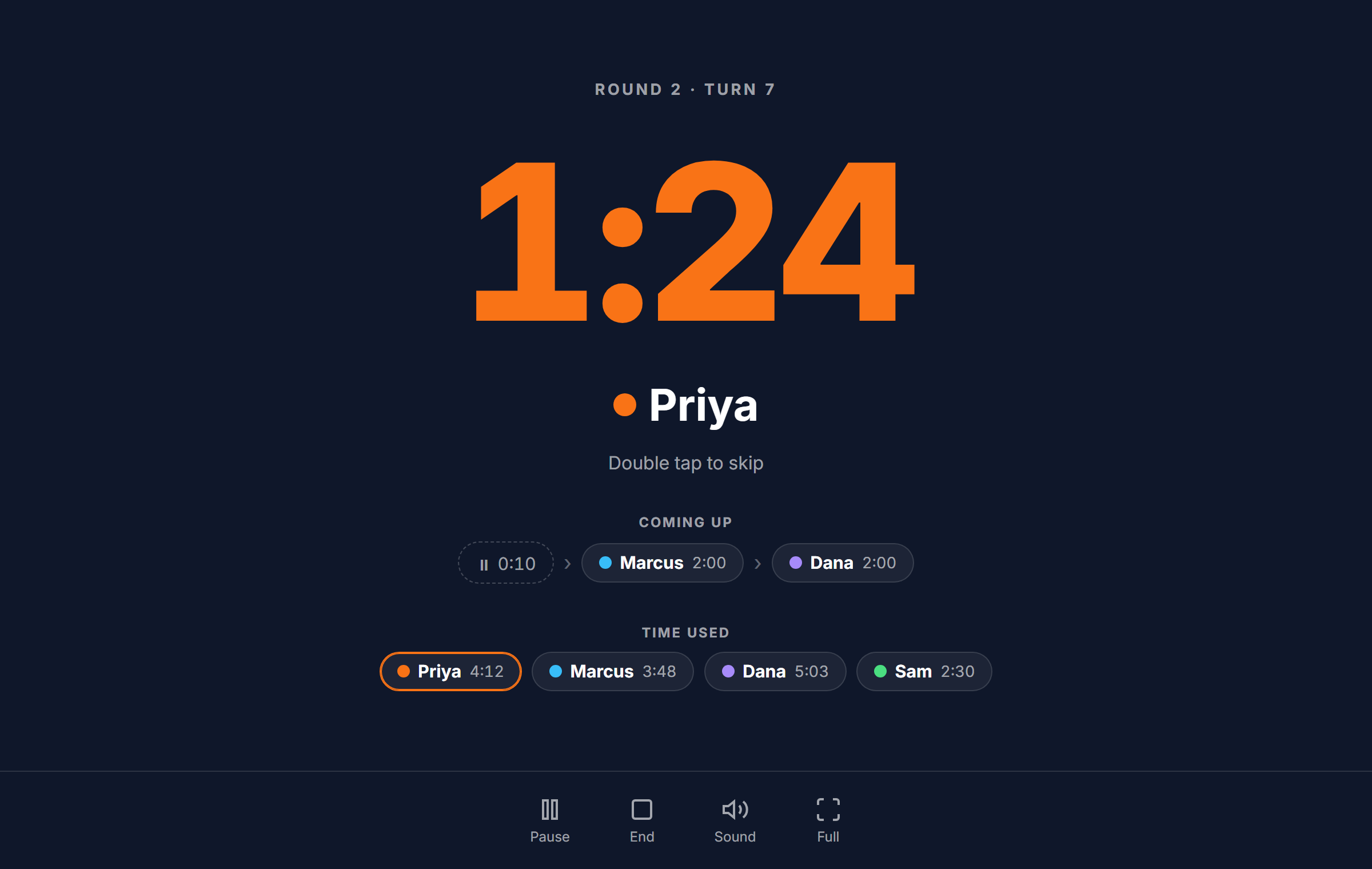
Here is what a turn timer looks like once a game is running. Each player has their own time, the clock counts down for whoever is up, the queue shows who is next, and a running total tracks where the evening is actually going.
Recommended settings by game
The feel column translates the community weight ratings that gamers already argue about into plain language. Break is whether a short handoff pause between turns earns its keep, which it does most in heavier games where the board changes a lot between players. Read every number as roughly, not exactly.
| Game | Feel | Time per turn | Break |
|---|---|---|---|
| Trivia night | Party, light | 20 to 30 sec | No |
| Codenames | Party, light | 30 to 45 sec | No |
| Wavelength | Party, light | 30 sec | No |
| Azul | Abstract, light | 45 sec | No |
| Splendor | Engine, light | 45 sec | No |
| Carcassonne | Tile laying, light | 45 sec | No |
| Ticket to Ride | Family, light | 45 to 60 sec | No |
| 7 Wonders | Drafting, medium | 45 sec | No |
| Scrabble | Word, medium | 60 sec | No |
| Catan | Family strategy, medium | 60 to 90 sec | Optional |
| Wingspan | Engine builder, medium | 75 to 90 sec | Optional |
| Everdell | Engine, medium | 90 sec | Optional |
| Root | Asymmetric, medium heavy | 90 sec to 2 min | Yes |
| Scythe | Strategy, heavy | 90 sec to 2 min | Optional |
| Brass Birmingham | Economic, heavy | 2 min | Optional |
| Agricola | Worker placement, heavy | 2 min | Optional |
| Terraforming Mars | Engine, heavy | 2 to 3 min | Yes |
| Twilight Imperium | Epic, very heavy | 3 to 4 min | Yes |
Chess is the deliberate omission. It has kept players on a clock for over a century, but it uses a cumulative time bank per player rather than a fresh countdown each move, which is a different tool. A per turn timer suits games where every turn should feel roughly equal; a chess clock suits a duel where you spend from a personal budget however you like.
A quick method for a game not on the list
Most games are not in any table, so here is a way to set one in about ten seconds. Picture a typical midgame turn and count the real decisions in it, not the fiddly upkeep, the choices that actually matter. One or two decisions is a light turn, three or four is medium, five or more is heavy.
Give each real decision fifteen to twenty seconds, then round to something clean. A two decision turn lands near forty five seconds, a four decision turn near ninety, and a big engine turn near two minutes. Now adjust for the room: knock off a third at a full table of five or six, add a third if it is anyone's first game, and loosen the first round while people find their feet. That is the whole method, and it gets you within a setting or two of right, which is close enough to fix by feel after a round.
It works because turn length is really a stand in for decisions, and decisions are something you can eyeball at the table without knowing a game's official weight. When in doubt, start a notch looser than you think and tighten, because a clock that begins generous is one nobody resents.
Turn length by player count
The single setting most worth adjusting is not on the box, it is who is at the table. The same game can feel brisk at three players and interminable at six, because downtime, the wait between your own turns, scales with everyone else's clock. At six players a ninety second turn means up to seven and a half minutes between your go; at three, it is three.
The practical rule is to shave the timer as the count rises. Take a game you would give ninety seconds at three or four players, and it usually wants sixty to seventy five at five or six. It feels counterintuitive to give people less time in the bigger, longer game, but the bigger game is exactly where a loose clock does the most damage, because every second is multiplied by every other player waiting on it.

Reading the table for your game
A few of these are worth unpacking, because they show how the same principle lands differently depending on what a turn actually asks of you.
Catan
A Catan turn is mostly trading and one or two builds, so 60 to 90 seconds is plenty once people know the map. The wrinkle is trading, which happens on other people's turns as much as your own. Keep the clock on the active player's build decision and let trade offers fly in the gaps, or the timer will feel like it is punishing the wrong thing. At five or six players, drop toward the low end and turn the buzzer on, because Catan at a full table is the classic case of everyone waiting on one slow trade.
Terraforming Mars
This is the poster child for a turn timer. Long turns and deep card combos make it the game most likely to run three hours, and a two to three minute clock with a break between turns cuts the worst of it without flattening the strategy. Give newer players the higher end and veterans the lower. The break matters more here than almost anywhere else, because the board and your tableau change so much between turns that people need a beat to read the state again before the clock starts.
Wingspan, Root, and the medium heavy middle
Engine builders like Wingspan and asymmetric games like Root sit in the tricky middle where turns are meaty but not epic. Ninety seconds is the sweet spot for most of them. The trap is the player building a big engine who wants to trigger it slowly and admire it; the clock is precisely the nudge that turns admiration back into action. In Root, where factions play completely differently, per player time is worth using so the fiddly faction gets a little more room than the simple one.
Scrabble and word games
Word games are the clearest case for a short, firm setting. Sixty seconds for Scrabble keeps the pressure that makes it fun and stops the ten minute stare at a rack. Party and trivia rounds go shorter still, because the fun is in the fast answer, not the perfect one.
Ticket to Ride and Azul
The gateway games are quick to time because a turn is usually one clean decision: claim a route, draw cards, take a set of tiles. Forty five to sixty seconds is generous, and the main thing a clock fixes here is the endgame, where players start counting everyone else's options before committing. If turns feel snappy already, leave the timer off until that final tense round and switch it on only then.
Card, party, and word games
These behave differently from a heavy strategy game and deserve their own rule of thumb. The fun in a party or word game is the pressure itself, so the clock is not a corrective, it is part of the design. Set it short and firm.
- Timed roles, not just turns. In Codenames the clue giver is the bottleneck, so put the clock on the clue, not the guessing. Thirty to forty five seconds is plenty to find a word, and it stops the ten minute hunt for the perfect double meaning.
- Keep it uniform. Party games rarely need per player time. Everyone on the same short clock is fairer and simpler, and the equal pressure is half the fun.
- Lean on the buzzer. Fast games live and die by a clear signal at zero. Leave the sound on and let it run the round.
Where to put the clock in games with shared actions
Some games blur whose turn it even is. Trading in Catan, auctions in a bidding game, drafting in 7 Wonders, and negotiation in anything with alliances all happen partly on other people's turns, and a clock aimed at the wrong moment feels unfair fast.
The rule is to time the decision that belongs to the active player and leave the shared talk loose. Put the clock on your build, not on the trade offers flying at you; on the auctioneer's call, not on everyone's bids; on the draft pick, not on the table chatter about what is coming around. If a game is mostly simultaneous, like a drafting round where everyone chooses at once, a single shared countdown for the whole round works better than a per player one, because there is no single active player to point the clock at. A plain countdown timer is often the right tool for that shared round.
Cooperative and campaign games
Cooperative games like Pandemic and campaign games like Gloomhaven slow down in a different way: through group discussion where everyone tries to solve everyone's turn. A hard per turn clock can fight the spirit of the game, so use it as a gentle budget for the table's talking rather than a hammer on one player. A looser setting with the active player deciding after a short discussion keeps the cooperation intact while still capping the spiral where three people plan one person's move for ten minutes.
Adjusting for your table
The table above is a room average. The real skill is bending it, and a good turn timer makes that easy rather than a house rule argument.
- Give different players different times. A new player on three minutes and a veteran on ninety seconds evens out a lopsided table without anyone being told to hurry up. This is the setting most groups reach for second, and it is why per player time exists.
- Start loose, then tighten. Set the higher end for the first round while people warm up, then drop it once the game finds its rhythm. Nobody minds a clock that starts generous.
- Add the break where the board is busy. In heavier games, a five to ten second handoff between turns is the difference between passing the device smoothly and fumbling it.
- Give the endgame a little slack. The final round or two, where a game is won or lost, is the one place a longer turn is worth it. If your group wants it, loosen the clock for the last lap.
- Let the buzzer do the nagging. A sound at zero means no one has to be the person who says time is up. The clock is the bad guy, and everyone stays friends.
All of these are one setting each in the turn timer: add players with their own times, toggle the break, and leave the buzzer on. If you would rather see the wider case for a game clock across chess, party games, and roleplaying, the game timer guide covers the whole landscape, and a plain countdown timer still works for a single shared limit.
Signs your setting is wrong
You will not nail it on the first try, and you do not need to. The game tells you which way to move if you watch for it.
- Too tight if people are regularly buzzed out mid decision, if the table groans at the sound rather than smiling, or if players stop planning and just grab the first legal move. Add fifteen to thirty seconds.
- Too loose if the buzzer almost never fires, if turns still sprawl, or if the clock has quietly become decoration nobody looks at. Trim thirty seconds and see if anyone even notices.
- Just right when the buzzer fires occasionally, mostly as a reminder rather than a cutoff, and the game keeps a steady rhythm without anyone feeling chased.
Time the whole game, or just the slow part?
You do not have to run the clock from the first turn to the last. Plenty of groups play the opening loose, where turns are quick and options are few, and switch the timer on only once the game hits the midgame grind where turns balloon. It keeps the early, exploratory part of a game relaxed and saves the pressure for the stretch that actually needs it.
The same trick works in reverse for the endgame. If your group treats the final scoring turns as the tense payoff and wants room to think there, run the clock through the middle and lift it for the last round. The point of a timer is to fix the part of the game that drags, not to police the parts that are already fun, so aim it at the grind and leave the rest alone.
Frequently asked questions
What if someone genuinely needs more time?
They will, occasionally, and that is fine. A missed turn is not a lost turn: when the clock runs out, most groups let the player finish the action they had started and simply move on. The timer is a nudge toward a decision, not a guillotine. If a game keeps needing more, the setting is too tight; add fifteen seconds and move on.
Do short timers ruin the strategy?
Usually the opposite. Given a limit, players commit to a plan and adapt to what happens, which tends to produce a better game than searching exhaustively for a move that is only marginally better. The strongest chess players in the world play excellent games in minutes. A time limit sharpens decisions more often than it dulls them.
Should the timer be strict or loose?
Loose to start, then as strict as your table enjoys. The point is pace, not policing. A group that likes the pressure can tighten the screws; a relaxed group can treat the buzzer as a gentle reminder. Both are correct, because both keep the game moving.
Do I set one time for everyone or one per player?
Start with one time for everyone, because it is simpler and usually enough. Reach for per player time the moment your table is genuinely uneven, a first game for one person and a fiftieth for another, or a game like Root where the factions differ. It is the fairest way to keep pace without making the slower player feel singled out.
What about the between turn break, is it worth it?
In light games, no. In heavy ones, often yes. A five to ten second pause between turns gives the next player a moment to read a board that changed a lot and to physically take the device, which is the difference between a smooth handoff and a fumble that eats the time you were trying to save.
Can I use this for two player games?
Yes, though a two player game is often where a chess clock, a cumulative bank per person, fits better than a per turn countdown, especially for abstracts and duels. For a two player Euro or a card game, a per turn timer is fine; just expect the pace to feel tighter, since there is no downtime to hide a slow turn behind.
Set these for your next game
Add your players, give each of them a time from the table, and it loops around the table for you. Free, no account needed, works on any phone or laptop.
Open the turn timer